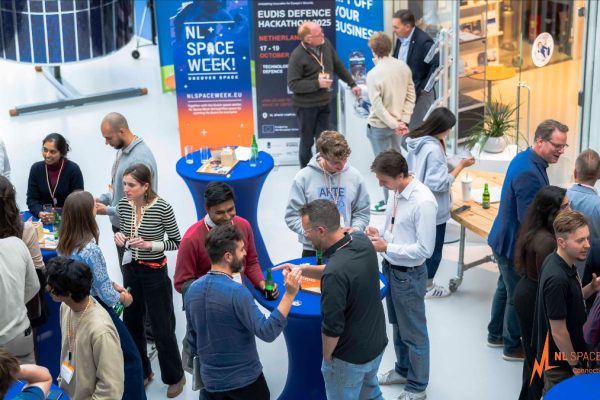
To boost the space-ecosystem in the south of Holland, the Province of South-Holland allocated an amount of €400.000 to the project ‘Doorontwikkeling campusorganisatie NL Space Campus’ for further development of the campus. This project is part of the ‘Kansen voor West’ programme which allocates €3 million in total to boost the five largest innovationcampuses in the region: TU Delft Campus, Leiden Bio Science Park, Biotech Campus Delft, NL Space Campus and Erasmus MC Campus. All campuses combined bring together a joint innovation ecosystem in which businesses and knowledge institutes connect and collaborate. Together with the four other campuses in the region, NL Space Campus plays an essential role in realising the ambitions of the province as defined in their Growth Agenda including: fueling innovation, creating and attracting new business and reducing CO2-emissions. The main focus of the project is to collectively boost the SME-driven innovation ecosystem and attracting talent to the space sector in order to strengthen the position of the Netherlands as a global frontrunner and key player in Space.


Importance of Dutch space technology on a global level
There is no denying the fundamental role of Dutch space data and technology in solving today’s societal challenges, and in the strategical autonomy of the Netherlands. Examples that underline the country’s capacity to take on a leading role in the development of space technology and data are Dutch groundbreaking technologies such as: satellite Tropomi which provides crucial data for solving climate-related challenges, Dutch satellite application GreySat which helps governments to globally map waste problems, the Tango satellite system which can very accurately identify and locate greenhouse gas emissions, and the Dutch measurement system SPEXone placed on NASA’s PACE climate satellite to provide crucial information in improving the accuracy of climate models.
NL Space Campus as the beating heart of the Dutch space ecosystem
When the Dutch government, the Province of South-Holland, the Municipality of Noordwijk and European space agency ESA recognised the vast potential in The Netherlands to boost the societal and economic value of space, this vision resulted in a joint Regiodeal in 2018. Based on this vision, NL Space Campus was founded with the ambition to boost the collaboration between the government, business and knowledge institutes in space.
This campus vision and the widely supported multiyear plan led to the phased development of the space ecosystem, including structural collaboration with the universities in Leiden, Delft and Rotterdam (Erasmus) in the LDE-alliance. Furthermore, the NL Space Campus foundation focuses on the physical development and government of the campus area in Noordwijk, which includes European knowledge institutes such as ESA (ESTEC), EUSPA (Galileo Reference Centre, GRC) and numerous space-related companies. Here, businesses from within as well as outside of the space sector connect and work together to fuel shared knowledge, joint innovations and boosting and attracting talent in the field of space technology and data: all in order to contribute to solving todays’ challenges in climate, sustainability and (cyber-) security.
Kansen voor West to boost growth and innovation in space
Eversince the start of the campus initiative, the aforementioned initiators proved to be progressive visionaries in realising the 2018 Regiodeal. In the past years, the campus programming has led to valuable dynamics within the space sector and the innovation ecosystem in general, creating various opportunities for cross-sector collaborations with non-space SME’s. The Kansen voor West programme provides the needed funds to further develop the necessary organisational, project-based and physical infrastructure of the NL Space Campus. Through its project ‘Doorontwikkeling campusorganisatie NL Space Campus’, the campus aims to realise more societal and economical impact of the space sector in The Netherlands. Furthermore, it will serve to further develop the campus as a dynamic hub of knowledge, facilities and business in space.
Through this project the successful ecosystem approach that is currently in place will be further strengthened, the space innovation-ecosystem will be enhanced to cater to new SME’s and will be increasingly more visible and inviting to new organisations from outside of the sector. This will help to accelerate and strengthen the programmes, projects and facilities that are crucial for space innovations and cross-overes with other sectors. Lastly, NL Space Campus aims to contribute to attracting new talent to the space sector through close collaborations with universities and upcoming programmes and facilities for the future CometLab. The resources provided through Kansen voor West greatly accelerate the realisation of these ambitions.